Vladimir Koci
His presentation was entitled “Revisiting Influenza Transmission Patterns Through a Novel Seasonality Index” in session OSA2.4 Human biometeorology
The Tromp Foundation established the Tromp foundation travel award to young scientists (TFTAYS) in 2016, with the aim to support scientists who present papers in the area of biometeorology at EMS Annual Meetings.

The submission of TFTAYS applications will open together with the call for abstracts in early February 2026; the application deadline will be 27 March 2026.
Details will be provided once the EMS2026 website is online.
The EMS and the Tromp Foundation invite applications for the Tromp foundation travel award to young scientists (TFTAYS) to support the participation of young scientists at the EMS Annual Meeting, 6 – 11 September 2026. These awards are funded by the Tromp Foundation, the legacy of Solco W. Tromp.
This award is specifically for presentations in the area of biometeorology.
The award consists of a waiver for the registration fee and financial support of 750€ for travel expenses to attend the Annual Meeting onsite in Utrecht.
Young scientists under 35 years of age on the first of January 2025 working and/or studying in a European country are eligible for an award. All countries with an EMS Member Society or included in the WMO RA VI region are considered as European. An overview of EMS Member Societies is available here.
This award is specifically for presentations in the area of biometeorology. Presentations in sessions Human Biometeorology, Agricultural and Forest Meteorology and Cities and urban areas in the earth-atmosphere system are treated with high priority; presentations in other related sessions could be considered as well, but the decision on eligibility is to the selection committee.
To apply the following procedures have to be followed:
(1) Submit your abstract for the EMS Annual Meeting until 27 March 2026 (including).
FAQs for abstract submission will become available in early February at the www.ems2026.eu
(2) Within the abstract submission tool, please tick that you would like to apply for the TFTAYS support scheme.
(3) Within the abstract submission tool, upload the following application details (in one pdf-file):
The applicant must be the presenting author of the submitted contribution. Note that award applicants have to pay Abstract Processing Fees at the time of submitting the abstract.
Applicants will be notified on the results of the selection process by 11 May 2026.
Any inquiries about the Tromp foundation travel award to young scientists (TFTAYS) can be sent to
ems-tromp-award( at )emetsoc(.)org.
Information about all EMS2026 support schemes will become available at www.ems2026.eu
A certificate will be presented to the awardees at the EMS2026 Awards Session on Monday 7 September 2026 in Utrecht. The award recipients are expected to provide a report on the conference to the Tromp Foundation. The award prize of 750€ is transferred to their bank account after receipt of the report. The Tromp Foundation would appreciate receiving a short (one to two mins.) video clip before the conference (instructions will be provided to awardees).
The awardees will receive a code to register for the conference.

His presentation was entitled “Revisiting Influenza Transmission Patterns Through a Novel Seasonality Index” in session OSA2.4 Human biometeorology
Carla gave a presentation entitled “Impacts of heat waves and cold waves in Ireland derived from documentary sources” in session UP3.4 Paleoclimatology and historical climatology
Xenia presented a poster entitled “Evaluation of heat and air pollution mitigation effects of urban green infrastructures and palisades in a Mediterranean urban high-density area – Scenario analyses based on microclimatological modelling” in session UP2.1 Cities and urban areas in the earth-atmosphere system
Andrea gave a presentation entitled “Effects of cumulative exposures to extreme weather events on children respiratory system” in session OSA2.4 Human biometeorology
Alexandra presented a poster entitled “Determining the historical and future impact of excess water limitation on winter wheat yields in Switzerland“ in session OSA2.2 Forests, agriculture and climates across scales
CIEMAT – Research Centre for Energy, Madrid, Spain
Beatriz Sanchez gave a presentation on “Past and future changes in the spatiotemporal distribution of heat stress in Madrid” in session UP2.1 Cities and urban areas in the earth-atmosphere system
Politecnico di Milano, Milano, Italy
Matej Žgela gave a presentation on “A geospatial approach for heat risk estimation by integrating remotely sensed and ground-based data in Milan, Italy” in session UP2.1 Cities and urban areas in the earth-atmosphere system
Departamento de Física de la Tierra y Astrofísica. Facultad de Física, Universidad Complutense de Madrid, Madrid, Spain
Pablo Ortiz-Corral gave a presentation on “Valley Breezes within a valley in Pyrenees: Vertical and Horizontal structure and its Evolution Over the Annual Cycle Through Observations” in session UP1.2 Atmospheric boundary-layer processes, turbulence and land-atmosphere interactions
Delft University of Technology, Delft, Netherlands
Zhikai Peng gave a presentation on “Exploring Tree Shade: Cooling Effects and Skin Temperature Recovery in Urban Environments” in session OSA2.5 Human biometeorology
Climate and Atmosphere Research Center, The Cyprus Institute, Aglantzia, Cyprus
Fragkeskos Kekkou presentation was entitled “Temperature Extremes and Human Health in Cyprus: Investigating the Impact of Heat and Cold Waves” in session OSA2.5 Human biometeorology
ELTE Eötvös Loránd University, Budapest, Hungary
Csilla Vincze gave a presentation on “Field-level analysis of phenological cycles and dynamics of sunflower (Helianthus annuus L.) and oil seed rape (Brassica napus L.) flowering within various regions of Hungary” in session OSA2.2 Agricultural and Forest Meteorology
University of Easter Piedmont, Vercelli, Italy
He gave a presentation on “Evaluating the Impact of Urbanization on Thermal Comfort in Turin: A Numerical Simulation Study” in session UP2.1 Cities and urban areas in the earth-atmosphere system
University of Cyprus, Civil and Environmental Engineering, Cyprus
His presentation was entitled “Multiscale numerical simulations of climate change impact on urban microclimate and human health” in session UP3.1 Climate change detection, assessment of trends, variability and extremes
Universidad Complutense de Madrid, Madrid, Spain
His presentation was entitled “How has the urban development of Madrid affected the local climate? Analysis of the last 50 years” in session UP2.1 Cities and urban areas in the earth-atmosphere system
Nicolaus Copernicus University, Toruń, Poland
His presentation was entitled “Bioclimate conditions in SW Greenland in the second half of the 18th century” in session UP3.4 Paleoclimatology and historical climatology
The Cyprus Institute, Nicosia, Cyprus
She gave a presentation on Quantification of the Urban Heat Island effect using paired station data in the Middle East and North Africa region in session UP2.1 Cities and urban areas in the earth-atmosphere system
University of Cologne, Cologne, Germany
He gave a presentation on Climate change adaption potentials of unsealing strategies in cities – An assessment during heat and drought events based on microclimatic simulations in session UP2.1 Cities and urban areas in the earth-atmosphere system
Department of Earth Sciences, University of Turin, Italy
He gave a presentation on The association between precipitation and the spread of shiga toxin-producing Escherichia coli infection in Lombardy, North of Italy in session OSA2.5 Atmospheric effects on humans
Research Centre Human Biometeorology, German Meteorological Service, Freiburg, Germany
He gave a presentation on Specific and localized heat warning system built upon normalized analysis of the UHI for the city of Karlsruhe – Results of GreenLung project in session OSA2.5 Atmospheric effects on humans
University of Zagreb, Faculty of Science, Department of Geophysics, Zagreb, Croatia
He gave a presentation on Future change in viticulture phenological stages and early frost risk in Istria region in session OSA2.2 Agricultural and Forest Meteorology
University of East Anglia, Norwich, UK
She gave a presentation on Weatherproofing for a smarter, resilient and more sustainable agrisector in session OSA2.2 Agricultural and Forest Meteorology
Department of Geophysics, Faculty of Science, University of Zagreb, Croatia
He gave a presentation on Comparison of land surface temperature of local climate zones in Croatia and estimation of the vulnerable population heat risk in session UP2.1 Cities and urban areas in the earth-atmosphere system
Meteorological Institute, CEN, Universität Hamburg, Hamburg, Germany
She gave a presentation on Parameterizing the impact of vegetated urban canopies on wind and temperature fields by using a simple nudging method in session UP2.1 Cities and urban areas in the earth-atmosphere system.
University of Sao Paulo, Intitute of Astronomy, Geophysics and Atmospheric Sciences, Atmospheric Sciences, São Paulo, Brazil
He gave a presentation on Association between COVID-19, mobility and environment in Brazilian capitals in session UP2.2 Interactions between air pollution, meteorology and the spread of COVID-19
University of Reading, Reading, United Kingdom
She gave a presentation on Borderless Heat Stress in session OSA2.4 Atmospheric effects on humans
Faculty of Envrionmental Sciences, Czech University of Life Sciences, Prague, Czechia; Institute of Atmospheric Physics, Prague, Czechia
He gave a presentation on Changes in heat-attributable deaths in Prague, Czech Republic, over 1982-2019 in session OSA2.4 Atmospheric effects on humans
University of São Paulo, Institute of Astronomy, Geophysics and Atmospheric Sciences, Department of Meteorology, Brazil
He gave a presentation on Casual relationships between particulate matter and COVID-19 cases in USA cities in session UP2.2 Interactions between air pollution, meteorology and the spread of COVID-19
Pavel Konstantinov, Lomonosov Moscow State University, Faculty of Geography, Meteorology and climatology, Moscow, Russian Federation
He presented a poster entitled Boundary layer inversions and human thermal comfort in Arctic cities (based on UHIARC measurements) in session OSA2.4 Atmospheric effects on humans
Moshe Mandelmilch, Tel Aviv University, Department of Geography and Human Environment School of Geosciences Faculty of Exact Sciences, Israel
He presented the paper Analysis of the Urban Heat Island magnitude in the Desert City of Beer-Sheva, Israel, Using a Modified Local Climate Zone Classification in session OSA2.4 Atmospheric effects on humans.
Dragan Milošević, Climatology and Hydrology Research Centre, Faculty of Sciences, University of Novi Sad, Serbia
He presented the paper Quantification of temporal changes of urban heat island intensity and cooling and heating rates in different local climate zones of mid-sized central European city in session OSA2.4 Atmospheric effects on humans.
Mohammad Taleghani, University of Salford, Manchester, United Kingdom.
He presented a poster entitled The impact of land cover on pedestrians’ thermal comfort within a university campus in session OSA2.4 Atmospheric effects on humans.

Dian Csenge , Eötvös Loránd University, Department of Meteorology, Budapest, Hungary.
She presented the paper Urban heat island intensity analyse based on surface and air temperature measurements in Budapest in session OSA2.5 Atmospheric effects on humans.

Mikhail Varentsov, Lomonosov Moscow State University, and A.M.Obukhov Institute of Atmospheric Physics RAS, Russian Federation.
He presented the paper Effects of the climate change and city development on summering urban heat island and heat stress indices for Moscow megacity in session OSA2.5 Atmospheric effects on humans.

Irena Nimac, Meteorological and Hydrological Service of Croatia, Zagreb, Croatia.
She presented the paper Urban climate of Zagreb (Croatia) – its characteristics and changes in session OSA2.5 Atmospheric effects on humans.

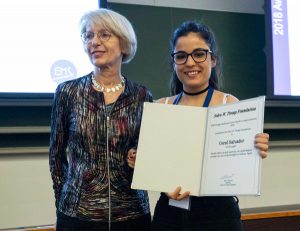
Coral Salvador, Environmental Physics Laboratory (EPhysLab), Facultade de Ciencias, Universidade de Vigo, Ourense, Spain.
She presented the paper Health effects on daily mortality of a hydrological extreme: the case of the droughts in Galicia, Spain in session OSA2.5 Atmospheric effects on humans.

Claudia Di Napoli, Department of Geography and Environmental Science, University of Reading.
She presented the paper Towards a pan-European forecasting system for heatwave-related health hazards in session OSA2.5 Atmospheric effects on humans.

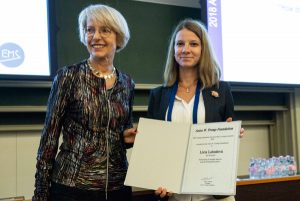
Lívia Labudová, Slovak Hydrometeorological Institute.
She presented the paper Monitoring of drought impacts and the DriDanube project in session ES1.3 Impacts: vulnerability and adaptation to climate change.
Olga Gommershtadt, presented the paper Modeling of summer thermal comfort conditions of Arctic city on microscale in session OSA2.8/ES1.7: Atmospheric effects on humans: Air quality,
biometeorology, urban climate and UV-radiation.
Mikhail I. Varentsov presented the paper Investigation of urban-caused mesoclimatic features of Moscow megacity in session OSA2.8/ES1.7: Atmospheric effects on humans: Air quality,
biometeorology, urban climate and UV-radiation
Anastasia Bleta presentated the paper Cardiovascular admissions related to particulate matter from 2.5 ?m to 80 ?m in Heraklion, Crete Island, Greece
Ajda Valher, Slovenia
Ajda Valher presented Crop water balance variability (abstract)in session ASI12 Phenology and agrometeorology.
Spyridon Paparrizos, Faculty of Environment and Natural Resources, Albert-Ludwigs University of Freiburg
Spyridon Paparrizos presented Present and future responses of growing degree days for Crete island in Greece in session ASI12 Phenology and agrometeorology
Pavel Konstantinov, Lomonosov Moscow State University, Faculty of Geography, Department of Meteorology and climatology
Pavel Konstantinov presented Urban Heat Island’s intensity research of Arctic city during winter and its influence on inhabitants’ thermal comfort in session ASI11 Urban Climate.
Michail I. Varentsov, Lomonosov Moscow State University, Faculty of Geography, Department of Meteorology and Climatology
Michail I. Varentsov presented Investigation of detailed spatial structure of the Moscow megacity climate features to the newest meteorological observations and regional climate modelling with connection to human comfort as poster in session session ASI11 Urban Climate
Jana Fischereit, Meteorologisches Institut, University of Hamburg
Jana Fischereit presented Assessing uncertainties for the calculation of perceived temperature in an urban environment in Session ASI7/CE10 Human Biometeorology.